


S30 Decoding your Vin
Each S30 Z-car is fitted with several information plates located in various positions, ranging from the firewall to the door frame. These plates contain key details about the vehicle’s identity, including VIN, production date, paint code, and other factory specifications.
Below is an example of a model plate and guidance on how to read it.

S30 Chassis Prefixes Explained
There is often confusion about what the S30 chassis prefixes mean. While this guide aims to be accurate, it may contain errors — input from experts is always welcome to ensure correctness.
American Market
- HLS30 — Datsun 240Z with L24 engine. Build dates start in 1969. “L” = Left-hand drive.
- RLS30 — Datsun 260Z with L26 engine. Build dates began in 1974.
- GRLS30 — Datsun 260Z 2+2 with L26 engine and two extra seats. Left-hand drive.
- HLS30 (later) — Datsun 280Z, same prefix but later chassis numbers. L-Jetronic fuel injection and US 5 mph bumpers.
Australian & European Market
- HS30 — Datsun 240Z. First car believed to be HS30-0004. L24 engine, 5-speed or automatic. Build dates from 1970.
- RS30 — Datsun 260Z, 2-seater only. L26 engine.
- GRS30 — Datsun 260Z 2+2. “G” = 4-seater. L26 engine. Produced until late 1977.
Japanese Domestic Market (JDM)
Home-market cars were sold as the Nissan Fairlady Z. Most have a 2.0 L engine; the 2.4 L 240Z models were only sold at home from late 1971 to 1973.
- S30 — Fairlady Z and Z-L (from October 1969). L20 2.0 L SOHC six (1998 cc) with twin SU-type carburetors, 130 PS at 6000 rpm. The model plate lists the engine as L20. 1973 cars were detuned to 125 PS for that year's emission rules.
- PS30 — Fairlady Z432. S20 2.0 L DOHC 24-valve six from the Skyline GT-R, three Mikuni-Solex carburetors, 160 PS at 7000 rpm. “432” stands for 4 valves per cylinder, 3 carburetors and 2 camshafts. About 420 built. More info
- PS30-SB — Fairlady Z432R, the lightweight racing version of the Z432 (no heater or radio). Fewer than 50 built. “SB” is a factory reference and isn't stamped in the chassis number. More info
- HS30 — Fairlady 240Z (from November 1971 to 1973). L24 2.4 L, 150 PS at 5600 rpm.
- HS30-H — Fairlady 240ZG (from October 1971), sold only in Japan. L24 engine with the “G-nose” aero nose, headlight covers and riveted fender flares. The “-H” is a factory reference.
- GS30 — Fairlady Z 2by2 (from January 1974). L20 engine, longer wheelbase and two small rear seats. “G” marks the 2+2.
- A-S30 / A-GS30 — 1975 cars. The L20 gained electronic fuel injection (L20E, 130 PS) to meet Japan's 1975 emission rules.
- C-S31 / C-GS31 — from late July 1976, with Nissan's NAPS emission system (EGR). The model code changed from S30 to S31, and the Z-T trim was added. Built until the S130 replaced it in 1978.
The “A-” and “C-” at the front are the emission-regulation part of the official Japanese model designation (A = 1975 rules, C = 1976 rules). The chassis number itself is written in the S30-, GS30-, S31- or GS31- form, followed by the serial number.
Breaking the VIN Down
The car serial number (chassis number) is stamped into the firewall on the driver's side, above the brake booster, on both left- and right-hand-drive cars. It can be hidden under paint, sealer or grime, so clean the area gently to read it. It also appears on the model plate in the engine bay.
US-market cars also carry a VIN tag on the driver's end of the dashboard, read through the windshield. Japanese home-market cars have no dashboard or door-jamb tag: on a Fairlady Z the firewall stamping and the model plate are the places to look.
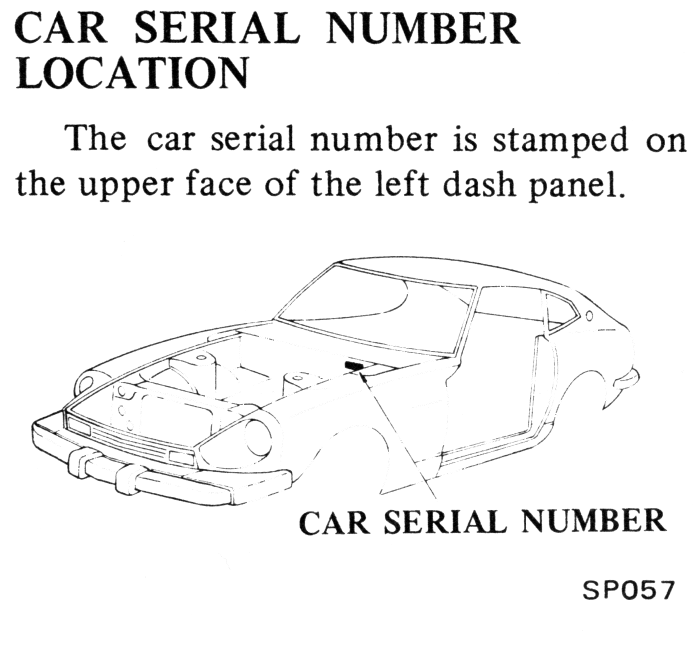
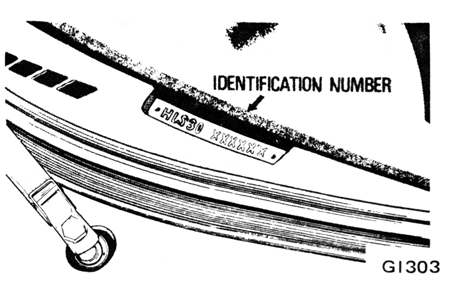
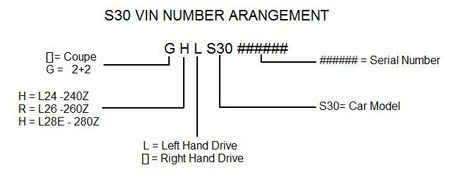
The VIN can be decoded as follows:
| VIN Position | Meaning | Example |
|---|---|---|
| Letters before “S30” | Engine, body and steering: H = larger L-series engine (L24; L28 on the 280Z), R = L26, P = S20 (Z432), G = 2+2, L = left-hand drive. No letters = the 2.0 L L20 Fairlady Z. | HL (US 240Z), G (JDM 2by2), none (JDM Fairlady Z) |
| S30 | Model series (S31 for Japanese cars from July 1976) | S30 |
| After the dash | Serial number, counted separately for each prefix | HLS30-12345, S30-01234 |
ID Plate
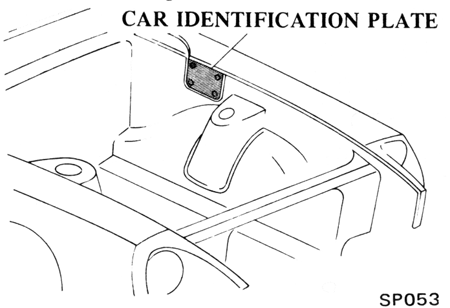
The model plate (Car ID plate) is riveted in the engine bay on the left side, on L-engine cars. On the PS30 Z432 it sits on the opposite side, because the S20's large air box over its three carburetors takes up that space.
Japanese-Market Fairlady Z Plates
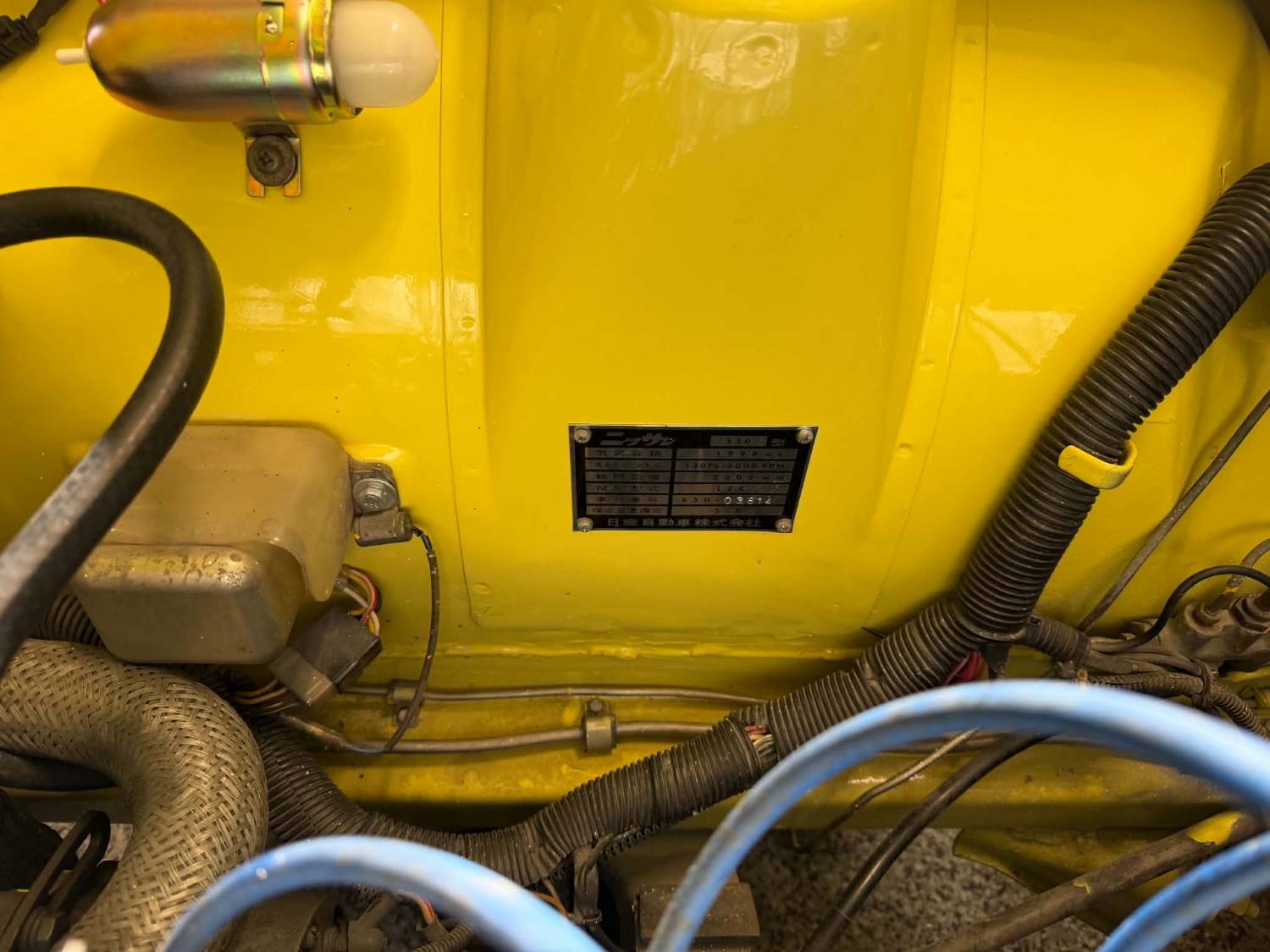
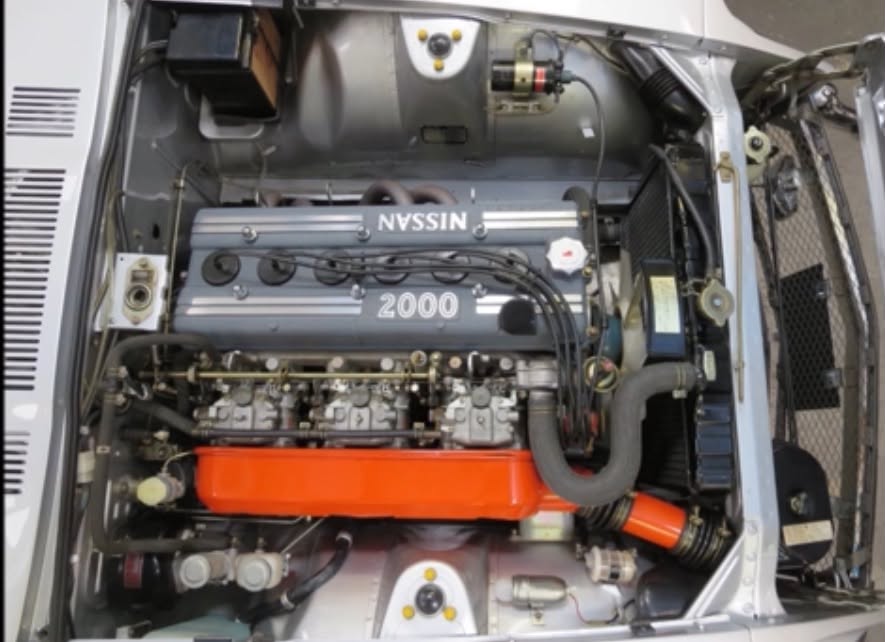
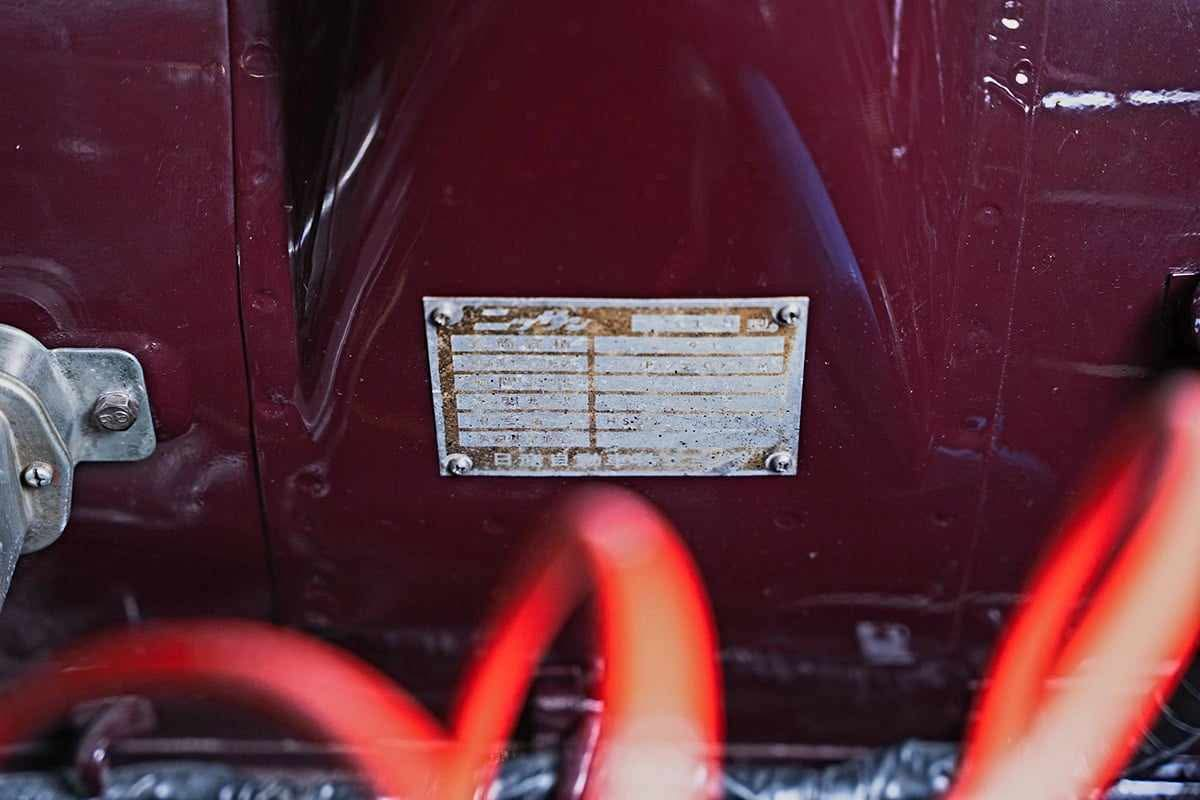
Export plates are in English. Japanese home-market plates read “ニッサン” at the top and list the same details in Japanese:
| Export plate | Japanese plate | Example (Fairlady Z) |
|---|---|---|
| Type | 型 (model) | S30 |
| Engine capacity | 総排気量 | 1998 cc |
| Max. horsepower | 最高出力 | 130 PS / 6000 rpm |
| Wheelbase | 軸間距離 | 2305 mm |
| Engine model | 原動機の型式 | L20 |
| Car serial No. | 車台番号 | S30-xxxxx |
| — | 類別区分番号 (type classification number) | Japanese registration reference |
Note that the plate gives the engine model (L20, L24, S20…), not the engine's own serial number. The engine number is stamped on the engine block.
Color Code Label
The body color number plate is attached to the top of the radiator core support.

More information on paint colors can be found here.
Sources Used
- 1970-1978 Datsun Factory Service Manuals
- Zhome.com
- Nissan Fairlady Z (S30), Wikipedia (Japanese model codes, engines and dates)
- Classic Zcar Club forum: firewall VIN location
- Fairlady Z owner Kirk Towner, for corrections to the Japanese section: the Japanese model plate and the PS30 plate location
- Photos: Kirk Towner (S30 Fairlady Z model plate), Kats Endo (PS30 Fairlady Z432 engine bay) and Jane Weitzmann (HS30-H Fairlady 240ZG model plate), used with permission